

Electric Vehicles at Autosports Group
In Stock Electric & Hybrid Cars in the Group

What is an EV?
An electric vehicle (EV) is any car or vehicle with a motor powered by electricity rather than liquid fuels.
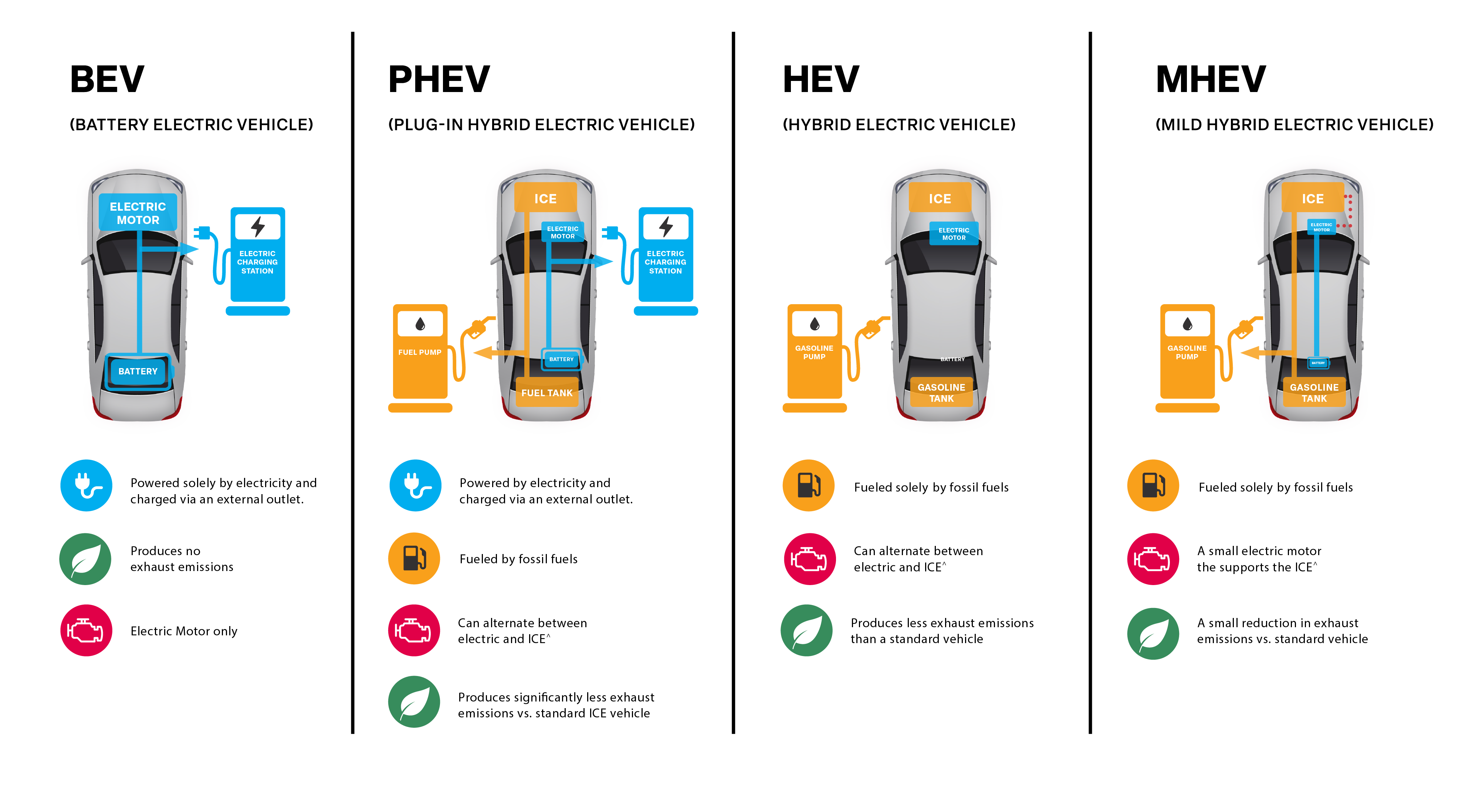
Types of EVs

Charging an EV
The charge rate is measured in kilowatts (kW), but it can also be useful to think of how many kilometres of driving range are gained per hour of charging.
Charging times can take as little as 10 minutes all the way to 24 hours to charge depending on where you charge it.
EV charging levels and range chart

Types of Charging Plugs

FAQs
- Reduced fuel costs and higher efficiency
- Less maintenance
- Fuel security
- Reduced traffic noise
- Air quality improvements
- Good for the environment
The cost of charging an electric vehicle (EV) depends on several factors, including where and how you charge.
Charging at home, especially if you use solar panels, is typically the most affordable option. On the other hand, public fast chargers tend to be more expensive due to the added convenience. Prices for fast charging vary depending on the charging network, your vehicle, and the charger’s power level.
The cost to fast charge an EV is still around 20% cheaper than buying petrol.
A kilowatt-hour (kWh) is a unit of energy used to measure the amount of electricity going into or coming out of an electric car's battery. In the context of EVs, it’s key to understanding how far the car can travel on a single charge and how efficiently it uses energy.
When charging an EV, the charger delivers energy in kWh increments, making it a crucial metric for estimating charging costs and range.
The driving range of electric vehicles (EVs) is improving rapidly thanks to advancements in battery technology. Many EVs available in Australia, including some of the most affordable options, can now travel over 400km on a single charge.
Premium models at the higher end of the market are pushing the boundaries even further, with ranges exceeding 600km becoming increasingly common. These innovations are expected to make their way into more affordable models over time, making long-distance EV travel more accessible for everyone.
Most electric vehicles have enough battery capacity to cover the average daily commute for most Australians for an entire week. This means, unless you’re planning a long road trip, you should only need to replenish the battery once or twice a week.
Charging your battery in accordance with the manufacturer's recommendations is important to prolong an EV battery’s life.
When deciding if you need a home charging system, the most basic considerations should be how much driving you plan to do and the type of EV you own (or are planning to purchase). These two factors will determine your required charging kW.
What type of EV you own
BEVs, with their larger battery packs, often justify the initial investment in a Level 2 charger given they rely solely on electricity to drive and often take impractical times to charge with Level 1 chargers.
However, A PHEV generally does not justify anything beyond Level 1 charging, as the smaller battery pack these EVs use will reach full capacity in a relatively short time.
How far you need to drive
For most Australians, Level 1 charging is sufficient for short daily commutes. However, for longer commutes or road trips, a Level 2 charger becomes much more practical as it significantly reduces charging time.
The exact charging process may change depending on the type of charging station, but this will usually be in relation to payment type.
Some chargers will require a dedicated card, or you may need to download a specific app which relates to the charge point operator (CPO). Others will allow payment using standard Visa, MasterCard debit and/or credit cards. Accepted payment types will normally be clearly displayed on or near the charger.
General steps to use an EV charger:
1. Connect one end of the charging cable to the charging station (if the cable is not already attached – some stations may have the cable attached).
2. If the charging station is free and does not require payment then the EV will start charging automatically. Otherwise, check the charger screen for further information.
To ensure the EV is charging, look out for indicator lights which will often appear on the vehicle display.
There will usually be information displayed on the charging station screen which will indicate charge times, charge capacity etc.
3. Once the EV is charged, disconnect all plugs, and leave the charger as you found it. This will ensure station care and courtesy for the next user.
When using a fast-charging station it is recommended the user charge to 80% state of charge (SoC). This will improve vehicle battery care and life.
Before you drive off, or if you need to pull over, the simplest way to find nearby EV charging stations is by using dedicated mobile apps. The PlugShare app offers a comprehensive map of charging stations, user reviews and real-time availability updates.
Other local network apps like Chargefox and Evie Network can help you find and pay for public charging.
There are many factors that impact your EV’s range that differ from the conditions used in the Worldwide Harmonised Light Vehicle Test Procedure (WLTP).
The Worldwide Harmonised Light Vehicle Test Procedure (WLTP) measures the range of a car travelling at an average speed of 46.5 kilometers in summer temperatures from a 100% to 0% state of charge. Since EVs are rarely driven until the battery is completely empty, the practical range often seems shorter than the WLTP-certified range. Although the certified WLTP range is not always achievable in real life, it does help to compare different car makes and models.
In real life, factors like vehicle weight, weather, road conditions, and driving behavior can significantly impact range. For instance, using climate control, carrying extra weight, or accelerating hard can reduce the distance you can travel.